
Narcissus 'Pheasant's Eye' and the best daffodils for naturalising
Narcissus poeticus var. recurvus, the pheasant's eye daffodil, is one of the very best daffodils for naturalising in grass. It flowers late, in late April and May, with pure white swept-back petals, a tiny red-rimmed eye and a wonderful scent, and it will spread steadily into lovely drifts over the years. Plant the bulbs from late summer to mid autumn, about 10 to 15cm deep, and leave the foliage uncut for at least six weeks after flowering.
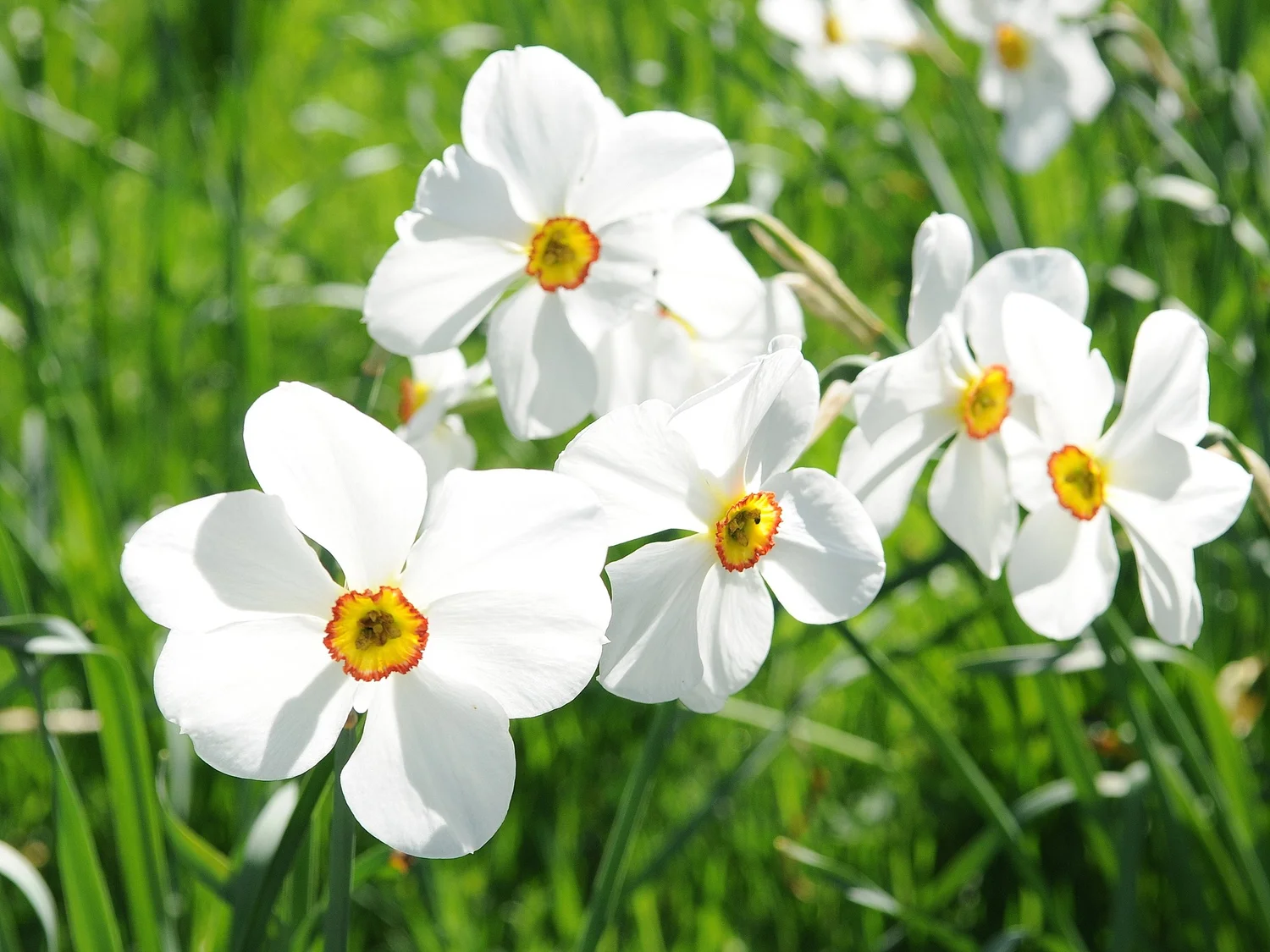
Why pheasant's eye is my favourite daffodil
Of all the spring bulbs, Narcissus 'Pheasant's Eye' is the one I would never be without. It arrives when most daffodils have finished, so it carries the season on into May just as the grass is lengthening and the first cow parsley is starting to froth. The flowers are simple and elegant: brilliant white petals that sweep slightly backwards, around a small, flat yellow cup edged in red with a green centre. That little eye is where the name comes from.
Then there is the scent. It is sweet, spicy and strong enough to notice from a few steps away, especially on a warm, still evening. Pick a small bunch for the house and it will fill a room.
Pheasant's eye carries daffodil season into May, just as the grass begins to grow long and soft.
Pheasant's eye at a glance
Flowers: late April to May, one of the last daffodils of the year.
Height: around 35 to 45cm.
Scent: sweet and strong.
Position: sun or light, dappled shade.
Soil: any reasonable soil that stays moist in spring. It copes well with heavier ground.
It is an old plant with a long history in gardens, and it has proved itself in orchards, meadows and old lawns across the country. That long track record is part of its charm: it is reliable, tough and settles in happily wherever it is given space.
How to naturalise daffodils in grass
Naturalising simply means planting bulbs so they look as though they arrived on their own, then letting them multiply year after year. Grass is the perfect setting, whether that is a corner of a lawn, the edge of a field, an orchard or a strip along a hedge.
When to plant
Daffodils root early, so the sooner they go in, the better. Late August to the end of September is ideal, but October planting is perfectly fine, and the bulbs will still flower well the following spring.
How to plant
For a natural look, take a handful of bulbs and gently toss them across the area, then plant each one roughly where it lands. This gives you those lovely irregular clusters with a few outliers, far nicer than neat rows. Plant each bulb about 10 to 15cm deep, which is around three times the height of the bulb, pointed end up.
A long-handled bulb planter makes the job quick on most soils: push it in, lift out a core, drop in the bulb and replace the plug. For larger drifts, you can cut and fold back a flap of turf with a spade, loosen the soil underneath, set out several bulbs and fold the turf back down.
Aftercare
The single most important thing is to leave the leaves alone after flowering. They feed the bulb for next year, so wait at least six weeks before mowing. With pheasant's eye flowering into May, that usually means the first cut comes in late June or July, which suits a relaxed, meadow-style area perfectly. You can mow paths through the longer grass in the meantime, which looks lovely and invites you in.
The best daffodils for naturalising
Pheasant's eye is wonderful on its own, but planting a few different daffodils together gives you a much longer season, from late winter all the way to May. These are all good choices for grass:
Narcissus pseudonarcissus: our native wild daffodil, or Lent lily, small and pale with a darker trumpet, flowering in March.
Narcissus 'February Gold': an early, golden yellow daffodil with slightly swept-back petals, flowering from late February into March.
Narcissus 'Jetfire': compact and cheerful, with yellow petals and an orange trumpet in March.
Narcissus 'W.P. Milner': a small, pale lemon trumpet daffodil with an old-fashioned charm.
Narcissus 'Thalia': pure white with two or three nodding flowers per stem, in April.
Narcissus 'Actaea': a poeticus daffodil similar to pheasant's eye but flowering a little earlier, a natural partner to stretch the season.
In general, the smaller, more delicate daffodils look most at home in grass. Big, heavy-headed varieties are better suited to borders and pots, where they will not look out of place.
Naturalising daffodils: checklist
Plant from late August to October, earlier if you can.
Scatter the bulbs and plant them where they fall.
Plant 10 to 15cm deep, pointed end up.
Use a bulb planter or lift flaps of turf for larger drifts.
Leave the foliage for at least six weeks after flowering before mowing.
Mix early, mid and late varieties for a season from February to May.
If you would like to see how bulbs sit within a wider planting through the year, my guide to planting a border that looks good all year is a good next read, and there are more seasonal jobs in what to do in the garden in October.
Quick answers
When does pheasant's eye daffodil flower?
Pheasant's eye flowers in late April and May, making it one of the last daffodils of the season. Exact timing varies a little with the weather and where you are in the UK.
How deep should I plant daffodils in grass?
Plant them about 10 to 15cm deep, roughly three times the height of the bulb. Deeper planting helps them stand firm and come back reliably.
When can I mow after daffodils?
Wait at least six weeks after the flowers fade, and ideally until the leaves begin to yellow. This lets the bulbs build up energy for next spring.
