
The best plants for bees and pollinators, month by month
The best plants for bees and pollinators are those with open, accessible flowers rich in nectar and pollen, chosen so that something is in flower in every month of the year. Think hellebores and crocus in late winter, fruit blossom in spring, nepeta and salvia in early summer, Echinacea and Sanguisorba in late summer, and asters and ivy in autumn. A steady succession of flowers is far more valuable than one big burst.
What makes a plant good for pollinators?
Single, open flowers are usually best, because pollinators can reach the nectar and pollen easily. Many heavily double flowers, bred for extra petals, offer much less. A variety of flower shapes helps too: bumblebees with long tongues love tubular flowers such as foxgloves, while hoverflies and smaller bees prefer flat, open flowers and umbels. Planting in generous groups makes each plant easier for insects to find.
It is also worth thinking beyond bees. Hoverflies, butterflies, moths and beetles all play their part, and many of them visit the same flowers. Night-scented plants such as honeysuckle help moths after dark, while native trees and hedges provide blossom early in the year. A garden with layers of trees, shrubs, perennials and bulbs will support the widest range of life, and it will look wonderful too.
Late winter: January and February
On mild days, queen bumblebees and honeybees venture out looking for food. Flowers now are precious.
Helleborus: choose single-flowered hellebores with open faces.
Crocus, especially Crocus tommasinianus, which opens wide in sunshine.
Lonicera fragrantissima: winter-flowering honeysuckle with sweet scent.
Sarcococca: tiny, highly scented flowers on an evergreen shrub.
Spring: March to May
As the season warms, more pollinators emerge and need plenty of food to build up colonies.
Pulmonaria: a favourite of the hairy-footed flower bee.
Salix (willows): pussy willow catkins are an early pollen source.
Fruit blossom: apple, pear, plum and cherry are wonderful for bees.
Erysimum 'Bowles's Mauve': flowers for months from spring onwards.
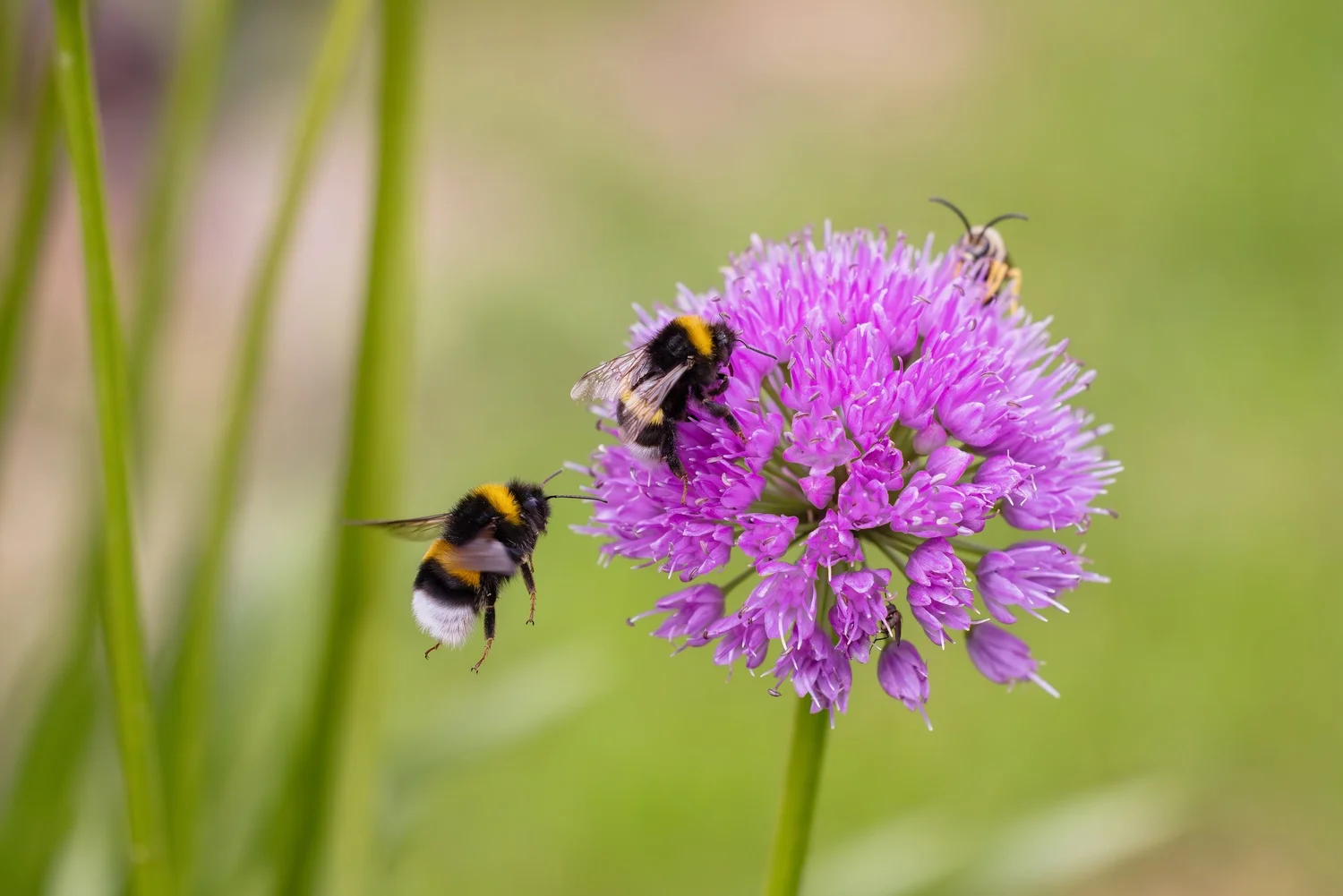
Allium hollandicum 'Purple Sensation': globe flowers loved by bees in late spring.
Bulbs bring real joy at this time of year. I love Tulipa 'Ballerina' and Narcissus 'Pheasant's Eye', and while showier spring bulbs are not the richest pollinator plants, they sit happily alongside the flowers above.
Early summer: June
This is a time of plenty, and borders can really hum with life.
Nepeta and Salvia nemorosa: long flowering and covered in bees. Cut back after the first flush for a second round.
Digitalis (foxgloves): ideal for long-tongued bumblebees.
Geranium 'Rozanne': flowers from early summer well into autumn.
Allium 'Mont Blanc': one of my favourite bulbs, with white globes that bees adore.
My post on geum, salvia and nepeta shows a lovely, pollinator-friendly combination for this time of year.
High summer: July and August
Lavandula (lavender): a magnet for bees on a sunny day.
Origanum (marjoram): small flowers loved by bees, hoverflies and butterflies.
Echinops and Eryngium: architectural globes and thistle shapes for bees.
Agastache: long spikes of nectar-rich flowers.
Echinacea: open daisy flowers that also give seedheads for birds.
Sanguisorba: my favourites include 'Cangshan Cranberry', 'Tanna' and Sanguisorba canadensis, all visited by bees.
Autumn: September to November
Late flowers help pollinators build up reserves before winter. This season is often overlooked, so it is worth planting deliberately for it.
Asters (Symphyotrichum): masses of daisy flowers well into autumn.
Hylotelephium (sedum): flat heads that butterflies and bees love.
Persicaria amplexicaulis: flowers from summer until the first frosts.
Hedera helix (ivy): its autumn flowers are a vital late food source for many insects.
Heptacodium miconioides: a small tree with scented late flowers.
Early winter: December
Mahonia × media: bright yellow, scented flowers through the darkest months.
Viburnum × bodnantense: pink, scented flowers on bare stems.
Simple ways to help pollinators
Alongside planting, avoid pesticides wherever you can, leave some areas a little untidy for nesting and overwintering insects, and provide a shallow source of water. Leaving stems standing over winter, as described in my October garden jobs, gives shelter too.
A year of pollinator plants
Late winter: hellebores, crocus, winter honeysuckle, sarcococca.
Spring: pulmonaria, willows, fruit blossom, erysimum, alliums.
Early summer: nepeta, salvia, foxgloves, geraniums.
High summer: lavender, marjoram, echinops, agastache, sanguisorba.
Autumn: asters, sedum, persicaria, ivy.
Early winter: mahonia, Viburnum × bodnantense.
Choose single, open flowers and plant in generous groups.
Quick answers
What is the number one plant for bees?
There is no single best plant, as different bees prefer different flowers. Nepeta, lavender, salvia and marjoram are among the most consistently popular in UK gardens.
Are double flowers bad for bees?
Many fully double flowers offer little or no nectar and pollen, because the parts that produce them have been replaced by extra petals. Single, open flowers are usually the better choice.
Do bees need flowers in winter?
Yes. On mild winter days some bumblebees and honeybees are active, so winter-flowering plants such as mahonia, hellebores and winter honeysuckle are valuable.
