
How to grow alliums, featuring Allium 'Mont Blanc'
Alliums are among the easiest bulbs you can grow: plant them in autumn, about 10 to 20cm deep in a sunny spot with free-draining soil, and they will flower from May into July with bold globes that bees adore. My favourite is Allium 'Mont Blanc', with big white heads on tall stems in early summer. Once you have grown them, the seedheads alone will keep you planting more.
Why grow alliums?
Alliums are ornamental onions, and they fill a really useful gap in the year, flowering after the tulips and before most summer perennials reach their peak. They bring structure to a border: perfect spheres floating above softer, looser planting. They are loved by bees and other pollinators, they are hardy, and they need very little looking after once they are in.
Best of all, the show does not stop when the flowers fade. Many alliums leave behind beautiful seedheads that stand for weeks and even months, catching frost and low sun well into autumn.
My favourite: Allium 'Mont Blanc'
Allium 'Mont Blanc' is a big, generous white allium with dense, rounded flower heads roughly the size of a grapefruit, held on strong stems of around 80cm to 1m. It flowers in early summer, usually in June. White flowers are so useful in planting because they lift everything around them and glow beautifully in the evening, and 'Mont Blanc' does that with real presence.
I like it rising through soft purple nepeta, deep blue salvias and the fine, airy texture of grasses. It works in both contemporary and cottage-style planting and gives a border a clean, fresh feel at the start of summer.
White alliums lift everything around them and keep glowing long after the sun has gone down.
Other alliums worth growing
Allium 'Purple Sensation': rich violet heads on 70 to 90cm stems in May and June. Reliable, affordable and lovely in drifts.
Allium cristophii: large, starry, metallic lilac heads on shorter stems of around 40 to 60cm in June. The seedheads are spectacular.
Allium 'Globemaster': huge violet globes on stems of around 80cm to 1m in early summer, a real statement plant.
Allium sphaerocephalon: small, egg-shaped drumsticks that open green and turn deep burgundy in July. Lovely threaded through grasses.
Allium nigrum: flat-topped, creamy white heads with a dark centre, around 60 to 80cm, in early summer.
How to plant alliums
When to plant
Plant allium bulbs from September to November. Earlier planting gives the bulbs time to root before winter, but anything in before the ground gets too cold will do well.
Where to plant
Alliums love sun and soil that drains well. On heavy clay, add some grit to the planting holes, or grow them in raised beds or pots. Avoid spots that stay wet over winter, as the bulbs prefer to rest in drier ground.
How deep and how far apart
Plant bulbs at around three to four times their own height. For big bulbs such as 'Mont Blanc' and 'Globemaster', that means about 15 to 20cm deep. Smaller types like Allium sphaerocephalon need around 10cm. Space large alliums 20 to 30cm apart, and smaller ones closer, around 10cm. Plant in loose groups or scatter them through a border for a natural rhythm.
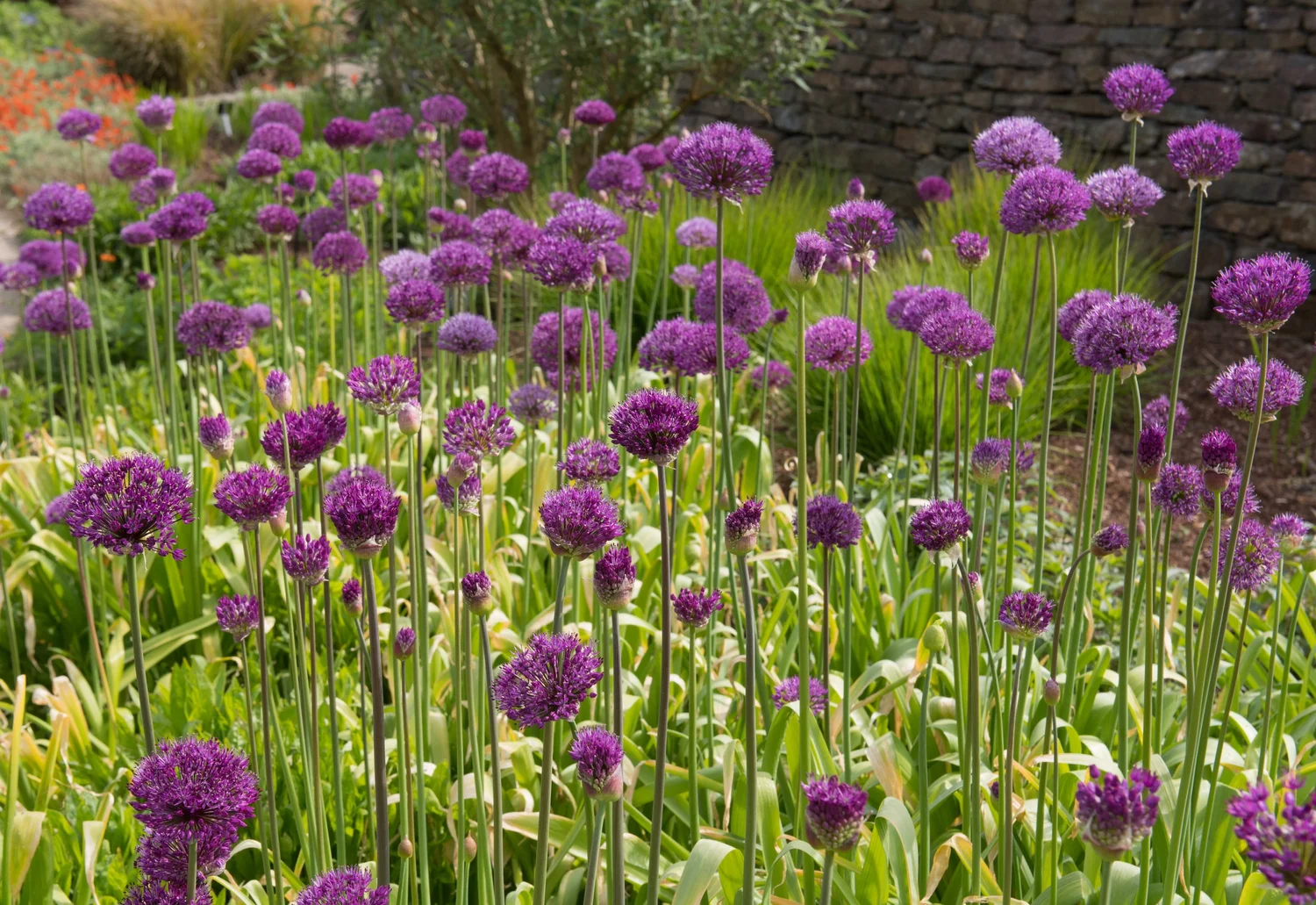
Planting partners
Allium leaves often begin to yellow just as the flowers open, which is perfectly natural. The best way to handle it is to plant alliums among perennials that grow up at the same time and hide the foliage. Good partners include:
Nepeta and salvias, which flower at the same time and share the same love of sun. There are more ideas in my post on geum, salvia and nepeta combinations.
Hardy geraniums, which knit together at ground level.
Grasses such as Stipa tenuissima, Sesleria and Deschampsia, which soften the strong shapes of the flower heads.
Sanguisorba, which takes over in later summer as the allium seedheads dry. See my plant of the month on sanguisorba.
Form Plants grows many of these perennials peat-free, which makes it easy to put a whole combination together at once.
Alliums at a glance
Plant: September to November.
Depth: three to four times bulb height, about 15 to 20cm for large bulbs.
Spacing: 20 to 30cm for large alliums, around 10cm for small ones.
Position: full sun, free-draining soil.
Flowering: May to July, depending on variety.
Aftercare: leave seedheads standing, let foliage die back naturally.
Aftercare
Alliums need very little from you. Let the leaves die back naturally so they can feed the bulb for next year, and leave the seedheads standing for as long as you enjoy them. Some alliums will gently self-seed, which is usually welcome. Most come back reliably year after year in a sunny, well-drained spot, and clumps will slowly bulk up.
If you grow them in pots, use a deep container with peat-free compost and plenty of grit, and keep it lightly moist through spring as the stems grow.
Quick answers
How deep do you plant allium bulbs?
Plant them at three to four times their own height. For large varieties like 'Mont Blanc', that is about 15 to 20cm deep. Smaller alliums need around 10cm.
Do alliums come back every year?
Yes, most alliums are reliable perennials in sun and free-draining soil, and many will slowly multiply over time.
Should I cut off allium seedheads?
There is no need. The seedheads look beautiful for months and add structure to the border into autumn. Cut them for drying indoors if you prefer.
